

“This is an animal that cannot compromise or adjust its way of life to ours. Could not by its very nature, could not even if we allowed it the opportunity, which we did not. For the grizzly bear there is no freedom but that of unbounded space, no life except its own. Without meekness, without a sign of humility, it has refused to accept our idea of what the world should be like.”
—Robert Porter Allen, American conservationist
June 1988, Ontario, Canada
A slim and serious young man stands in a field, sealed within a suit of armor, facing a 4,000-pound pickup truck. Between the man and the truck stands a camera crew. The young man’s armor is jet black and intimidating, somehow both medieval and apocalyptic. His chest and limbs are covered in the kind of protective sheets expected in plate mail, but a closer look reveals his helmet is meant for riding a motorcycle. Across his gauntlets one can clearly make out the word “Cooper,” Canada’s premier manufacturer of ice-hockey equipment. His shoes are regular old construction boots. Several key coupling points of the ensemble are held together with duct tape.
The pickup truck shifts into gear. It crawls across the field, rocking from side to side over uneven terrain. The young man holds his ground. The truck picks up momentum, the speedometer’s needle climbing past 10, then 20 kilometers per hour. The young man braces himself. Thirty is what he’s looking for—fast enough to simulate the raw power of his prospective foe, according to his calculations. The driver gives him what he wants, leaning more heavily on the accelerator.
Unflinchingly, the young man accepts the impact, twisting midair and skidding 15 feet across the grass. He lands face down and lies limp, his condition unclear. The driver steps out of the truck, unfazed, and walks over to check on his son.
The young man on the ground is Troy Hurtubise (pronounced “HURCH-uh-bees”). Though he’s only 24 years old, Troy is already seven things: inventor, writer, filmmaker, natural-resources technologist, expedition leader, martial artist, and bear behavioral specialist. At least, that’s what his CV says. This afternoon, he’s testing a suit of armor that he believes will allow him to pioneer a new field of biology: close-quarters bear research.
The suit is called the Ursus. While Troy doesn’t yet know it, the carapace he’s wearing is only the first in a long line of progressively more impenetrable Ursuses that he’ll design and refine obsessively until the day he abruptly dies. Over the decades, he’ll enlist dozens of volunteers to assist him in testing the suits against speeding vehicles, swinging logs, pillars of flame, and, of course, live bears. His death-defying experiments, many caught on film, will make him briefly famous, and he’ll be called an innovator, a charlatan, a genius, and an idiot. As a relentless self-mythologizer known for speaking like a Jack London character and carrying an array of throwing knives, he’ll only play into the image. History, if it remembers Troy at all, will never quite figure out where to slot him, but his life’s work will puzzle, inspire, and infuriate those who loved him for years to come. He’ll call his quest Project Grizzly.
Troy’s father, Maurice, helps him to his feet and dusts him off. The camera crew closes in as the two exchange notes on the collision. It went well, they agree. The Ursus held up admirably. But will it withstand the fury of a charging grizzly? Too soon to tell. More data is required. Maurice climbs back into the truck and reverses across the field while Troy steps back into position. “Action!” Troy calls out to the crew. He steadies himself, and his father puts his foot to the pedal.


Troy Hurtubise was born in Toronto on November 23, 1963, which means that from the very beginning, he likely wasn’t given the attention he thought he deserved: John F. Kennedy had been shot the previous afternoon. Troy spent his early years in Windsor, Ontario, Canada’s southernmost city, an auto-manufacturing town. The Hurtubises were poor. Troy’s mother, Claudette, was too busy raising him and his five siblings to work outside the house, and Troy’s father, Maurice, was often preoccupied with drinking, and only sporadically and eccentrically employed. Maurice was, by turns, a border agent, a studying anthropologist, a theater director, and a high school English teacher. He was a tinkerer obsessed with taking apart his own car, a history buff, and an avid whittler of homemade chess sets. When Maurice was engrossed, everything was exciting. When he wasn’t, the Hurtubise home turned into a house of screaming, of hitting, of broken bones. Troy was terrified of his father. He also worshipped him.
As a boy, Troy also idolized Hollywood action heroes like Bruce Lee and Sylvester Stallone, and began training in martial arts at age 7. He dreamed of becoming a stuntman. He rehearsed for the role by scaling local backstops and leaping off, crumpling into a bloody, smiling heap on the dirt, and by rolling off the roof of the garage onto the cement driveway, pretending to die in front of the neighbors. He wanted to be a leader fearlessly commanding a battalion, and whichever ledge he rolled off, his younger brothers Stacy and Blair followed.
Like the men he adored, Troy hated sleeves and hated being indoors. His fondest memories were of barreling shirtless through the bush, brothers in tow, pretending he was fictional mountain man Jeremiah Johnson, played by Robert Redford in the film of the same name. Troy was in heaven when, for three summers in middle school, Maurice carted the family off to the forest to live in a one-room log cabin built in 1898. As part of his anthropology training, Maurice was tirelessly constructing a sprawling replica of a walled Iroquois village, circa 1000 CE, in a nearby clearing. The family carried fresh water from a well a mile away, cooked over an open flame, and slept, all eight of them, in sleeping bags on the floor.
As an adolescent, Troy became obsessed with American singers. He developed an excellent impression of Johnny Cash, and he learned to flawlessly mimic all the dance moves of Elvis Presley, his father’s favorite musical artist, whose hairstyle Troy adopted and meticulously maintained his entire life.
In school, Troy was eager to excel—sometimes overeager. His mother often warned him against trying to run before he could crawl, but after grade nine, his enthusiasm for learning turned to impatience. He dropped out at 16, to the whole family’s shame. Maurice issued him an ultimatum: Re-enroll in school, or leave home. Never one to back down, Troy moved out.
For five years, Troy drifted through what he would later describe in his first self-published memoir as “The University of Life.” He worked odd jobs, quitting often, and surfed friends’ couches. Mostly, he roamed around his hometown in a pickup truck, loading the bed with stray scrap metal to sell at the junkyard. He didn’t know what he wanted, but he felt called by the wilderness. Whenever he could get the money together for a Greyhound ticket, he caught a bus to British Columbia and disappeared into the bush, spending his days surviving, pondering, and panning for gold.
In 1984, when he was 20, Troy’s listlessness suddenly ended when he accidentally startled an adult male grizzly deep in the bush.
Troy had been portaging a rubber dinghy down a narrow trail. The bow was draped over his forehead, obscuring his vision. The grizzly charged Troy, headbutting him, sending him and his dinghy skyward through a small meadow. There, he lay helpless on the ground while the bear roared in his face. He pissed and shit his pants. Then a strange calm replaced his terror. He recognized it as the feeling of being certain he was about to die. He drew his knives and stood up.
“Alright, Old Man,” Troy said. It felt somehow appropriate to address his soon-to-be murderer by name, and since the bear had neglected to introduce itself, Troy invented a moniker inspired by the distinctive white tuft underneath the animal’s chin.
“You’re going to kill me as sure as I’m standing here, because your fighting prowess is 50 times mine. But I am so pissed off about all the bullshit you put me through that, before I go down, I’m going to take both of these”—he raised his blades—“and as sure as God made little green apples, I’m gonna shove them right up your ass. And that’s a fact.”
The bear stared at Troy, bemused. Troy stood still. Each held his ground, and a long time passed before something truly strange happened. The bear’s lips curled into the shape of a smile, and then, grinning, it turned 180 degrees and disappeared into the trees.
According to Troy, anyway. The Old Man Story, as he came to call it, is one he told many times, whenever he had the opportunity, to friends, fellow students, newspaper reporters, television crews, and total strangers. Always the same in essence, but differing slightly in the details, it became his Captain Ahab–esque origin story, which he would reenact theatrically as an impromptu one-man show. Playing both roles (himself and the bear), he would hurl himself onto the floor and relive the encounter in real time in front of his audience.
Later, Troy would write that the Old Man gifted him “focus, direction, and a goal in life” that day when he nearly killed him. Like the survivors of many catastrophes, he became fascinated by and obsessed with the force that had nearly destroyed him, consuming every book he could find on the subject. He decided he would dedicate his life to the study of the North American grizzly bear.

The Hurtubise cabin
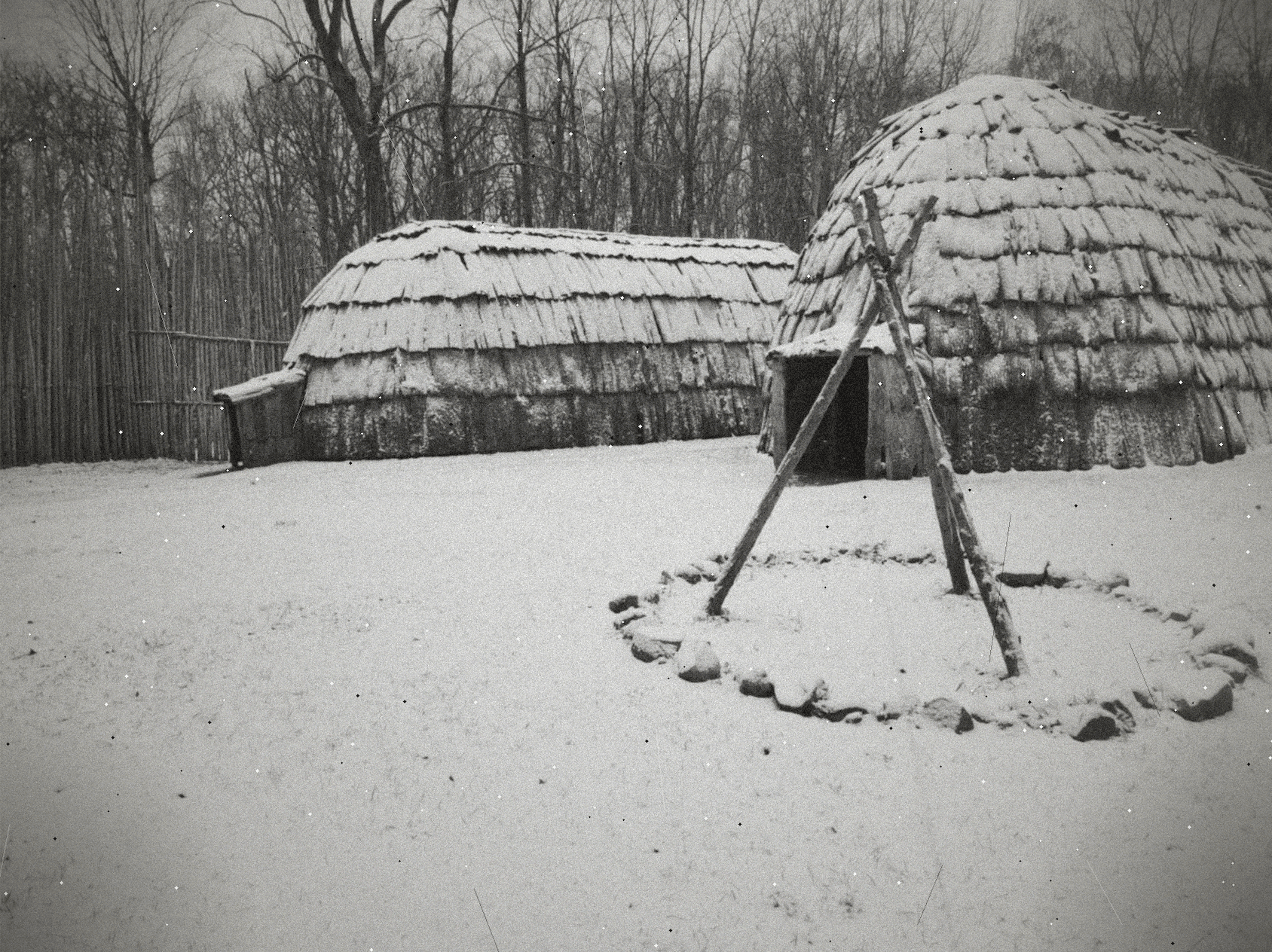
Maurice's village
In time, Troy decided to give the sublime, life-affirming adrenaline he felt looking into the Old Man’s eyes a name. He called it The Edge, and finding it and staring over it became his obsession. Grizzly bear field researcher seemed like the perfect profession to regularly encounter The Edge. Troy knew, however, that not just anybody was legally permitted to study grizzly bears, so he swallowed his pride, moved back in with his parents, and went back to school. Maurice welcomed Troy’s return, but he kept his wayward son at an icy distance.
Eager to prove to Maurice that he could get his life back on track, Troy completed his remaining three years of high school coursework in the space of one year, in an adult-education program. It was an experience so hauntingly boring that he later described it as something like a Greek hero’s visit to the underworld: “Faces, aged hard by time and failure, passed unaware of my presence [in] what looked to me…like a place out of time.” Then, at 24, he enrolled as a freshman in Sir Sandford Fleming College, a small technical school, to study to become a natural-resources technician. It was the first step toward becoming a bona fide bear researcher.
Arriving at Fleming, Troy soon realized that college was no more exciting than high school. His courses had names like “Plant Materials and Plant Maintenance,” “Pathology and Weed Science,” “Park Law,” and “Turf Grass Diseases.” In the mornings, he’d drink coffee brewed over a fire he built out of a tin cup, then spend his days studying, practicing martial arts on the quad, and eating steaks he sliced with his Bowie knife.
Between 1984 and 1987, Troy logged 4,000 hours—almost a full six months—reading about bears. He signed off on the vast majority of the scientific literature but gradually became fixated on what he considered a gaping hole in the testing of bear repellents. Bear spray hit the market in 1986, to widespread acclaim, after being tested on caged grizzlies at the University of Montana. However, unknown to most hunters and hikers, it had never been tested on wild bears in real-life conditions. This fact puzzled and angered Troy. Didn’t the public have a right to know that what they were purchasing was unproven under field conditions?
Troy wanted nothing more than to test the spray himself on wild grizzlies, an experiment that would neatly dovetail his scientific ambitions with his aching desire to stare death in the face. But he couldn’t think of how to safely get close to the devils. He was lucky to get away from the Old Man with his life the first time. The problem consumed him, until one rainy afternoon when he decided to kill time by watching RoboCop on VHS. After 30 minutes of observing the film’s protagonist, steel-sheathed and indestructible, the obvious solution appeared to him fully formed, like Athena from the head of Zeus.
“YES!” he shouted aloud at his empty bedroom, still seated in front of his TV. “YES!”
Mere weeks later, Troy was darting to and fro across the stage of Fleming’s largest lecture hall. It was packed with students, faculty, and scribbling members of the local press, all drawn by the mysterious poster he’d pinned to the school bulletin board: “Job Application: Looking for six individuals to partake in a three-week expedition into the heart of British Columbia. Job: Conducting scientific research on the North American grizzly bear.” Assessing the crowd over his scant mustache, Troy felt sure they assumed that he was the assistant and some internationally respected outdoorsman would soon stride in and assume his position at the lectern. Undeterred, Troy cleared his throat and began speaking. He lectured for two hours straight.
The first hour, he explained the problem, that bear-repellent sprays had been tested only under lab conditions and were therefore potentially ineffective against wild grizzlies. The second hour, he unveiled the solution, a method of testing such sprays in a myriad of real-life conditions against real, pissed-off grizzlies. He would construct a mobile and virtually indestructible barrier between Man and Bear, which would nevertheless allow Man to observe and interact with Bear: a bear-proof suit of armor. He called it the Ursus Protective Suit, after the grizzly’s Latin name, Ursus arctos horribilis. He called the effort to build and test the suit Project Grizzly.
Testing the Ursus, he explained with the help of various diagrams, would entail an elaborate arrangement of three steel cages suspended from trees deep in the forest. Bait, in the form of a pile of decomposing carcasses (deer, elk, et cetera), would be positioned centrally among them. The first cage would house a camera crew, ready to capture everything with the latest in audio/visual technology; the second would house a sharpshooter, ready to let fly a hailstorm of rubber bullets at a moment’s notice; the third would contain Troy Hurtubise, further encased within the Ursus Protective Suit.
When a bear approached the bait—and it surely would, Troy added, because a grizzly can smell a kill at 7 miles—Troy would emerge from his cage and charge it, provoking an attack. Absorbing bites and blows, he would then retreat back into the cage and, from there, blast the bear in the face with a high-powered pepper spray. Scientific protocol would require that the crew repeat this test four times on four bears. If the spray proved effective in all trials, Troy said, for the fifth trial, he would remain outside the cage with nothing to defend him but the Ursus Protective Suit, covering fire from the sharpshooter (if necessary), and his 17 years of martial-arts experience.
As he spoke, Troy channeled the confidence and charisma of his childhood heroes, Clint Eastwood and Sly Stallone, and he reminded himself of something his father always told him, one of the only compliments he could ever remember receiving from Maurice: “Troy, you could sell a lighter to the devil.”
“I’ve covered all the angles,” he said in closing, making eye contact with the entire crowd. “We’ll be out there making bear history.”
Out of dozens of applicants, Troy selected six individuals to accompany him on his expedition. They were a ragtag crew, each deficient in his own way, but Troy believed that together they composed an unstoppable whole. They were good men, and, counting Troy, there were seven of them, so Troy called them the Seven Good Men.
The first good man was Andrew Langer, aka “McKinney.” McKinney was to be Project Grizzly’s still photographer and weapons technician, as well as the writer, director, and producer of the documentary films the team intended to edit together out of the visually and scientifically spectacular footage they were sure to capture. It was Troy who gave Langer the nickname “McKinney”—and then forgot why. Inexplicably, he later speculated that it was because McKinney was “so damn pessimistic.” That gritty realism would counterbalance Troy’s exuberance and lend Project Grizzly its focus.
The second good man was Paul Hopkins. Bearded and balding, Hopkins would serve as the team’s sharpshooter. He was chosen for his deadly accuracy and his coolness under pressure. He’d be the one to decide when, if ever, to rescue Troy with covering fire in case the Ursus Protective Suit and Troy’s martial-arts abilities failed. He would also double as the team’s chef, responsible for three-times-seven meals daily. Hopkins would be the project’s strength.
The third was Wayne McLeod, assistant still photographer, assistant field technical writer, and cartographer. Round-faced and mild-mannered, McLeod was selected less for his physical prowess or derring-do than for his quiet mental fortitude. Troy was inspired by the fact that he had diabetes but didn’t take any medication. For this reason, McLeod would embody the project’s courage.
The fourth was Ronald Cormier, lead field technical writer, responsible for authoring the meticulous field journals that would serve as the source material for the team’s forthcoming scientific publications. Cormier was chosen primarily because he was hilarious—a quality Troy felt was not to be overlooked when setting out on a potentially life-threatening expedition. He would keep spirits high and tensions low, serving as the project’s sense of humor.
The fifth, sixth, and seventh good men were a trio of Hurtubises: Blair, Stacy, and Troy. Blair, Troy’s youngest brother, was a shy, slight, and stoic man still finding his way in the world. He would serve as lead camera operator. Stacy, the middle brother and lead field technician, was wider than those on either side of him, a hockey player prone to wearing baseball caps backward.
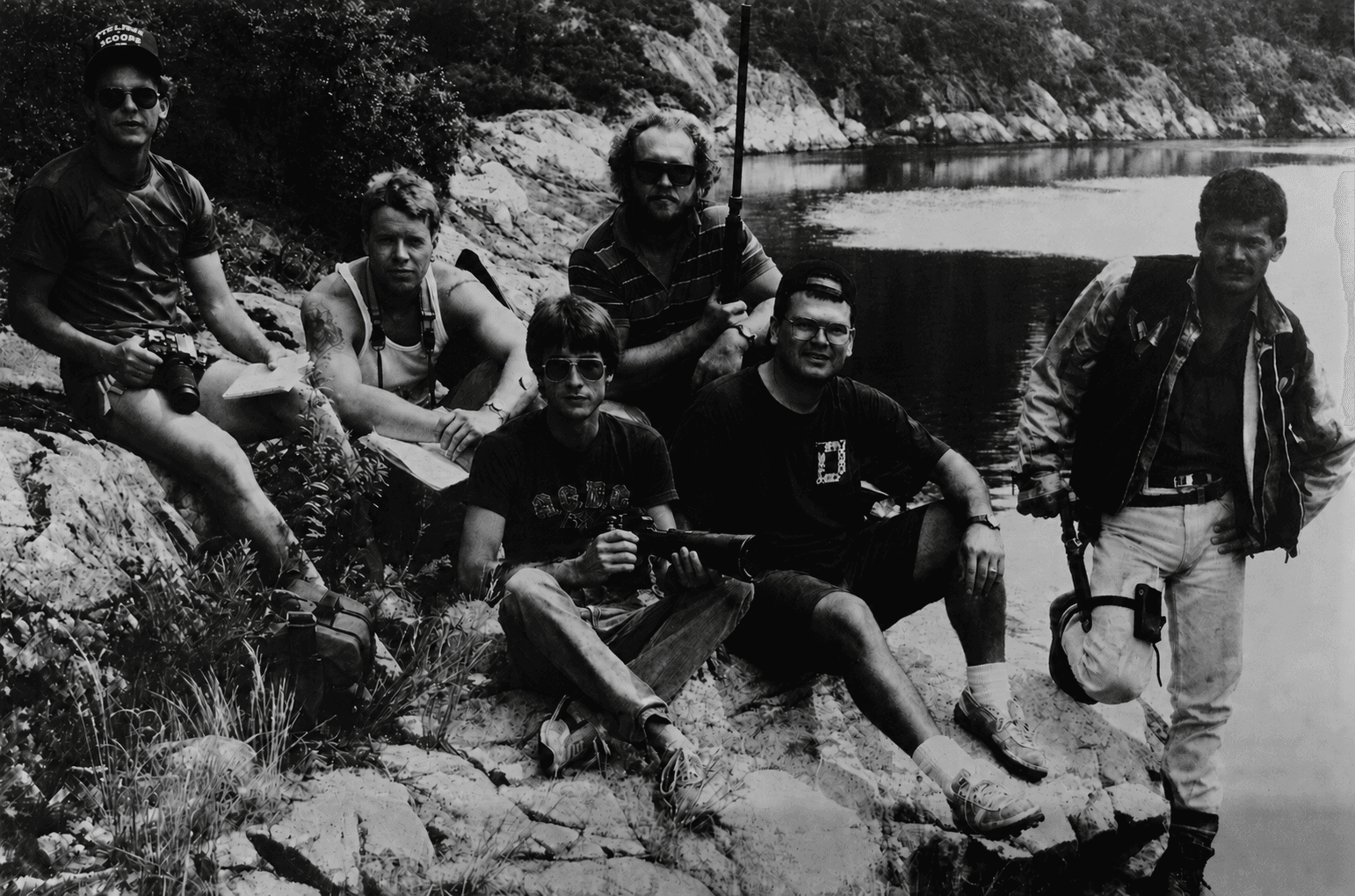
The Seven Good Men, minus photographer Blair Hurtubise
Word of Project Grizzly’s intentions spread fast. The local newspapers ran their pieces about Troy’s lecture in mid-December, and soon others across Ontario picked up the story. Then the Edmonton Journal and the Calgary Herald printed articles in Alberta, and the Vancouver Sun in British Columbia, and soon Troy’s smiling face was on front pages across the Commonwealth, as far as Australia. It was good press, but it also alerted the authorities, and the parks minister informed Troy in early January 1988 that the entire idea was probably illegal.
“Dear Mr. Hurtubise,” the minister’s letter began. “A recent article in the Vancouver Sun outlines your plans to deliberately place yourself in a position to be mauled by a grizzly bear in Northern B.C. next summer, in order to test a repellent spray. This is to advise you that such a contemplated action may be in violation of the Environmental Management Act and Wildlife Act in B.C. It is not our intention to allow this to occur.”
Fine, Troy thought. Ever the optimist, he chose to interpret the setback as an opportunity for prudence. After all, the Seven Good Men weren’t ready to face a grizzly yet anyway. The claws, the teeth, the speed. A full-grown, 800-pound grizzly can sprint at 30 miles per hour, over uneven ground, uphill. They’re horrifying creatures. Instead, Project Grizzly would conduct preliminary tests of the Ursus Protective Suit on black bears, which possess relatively smaller claws and teeth and were numerous then in Ontario.
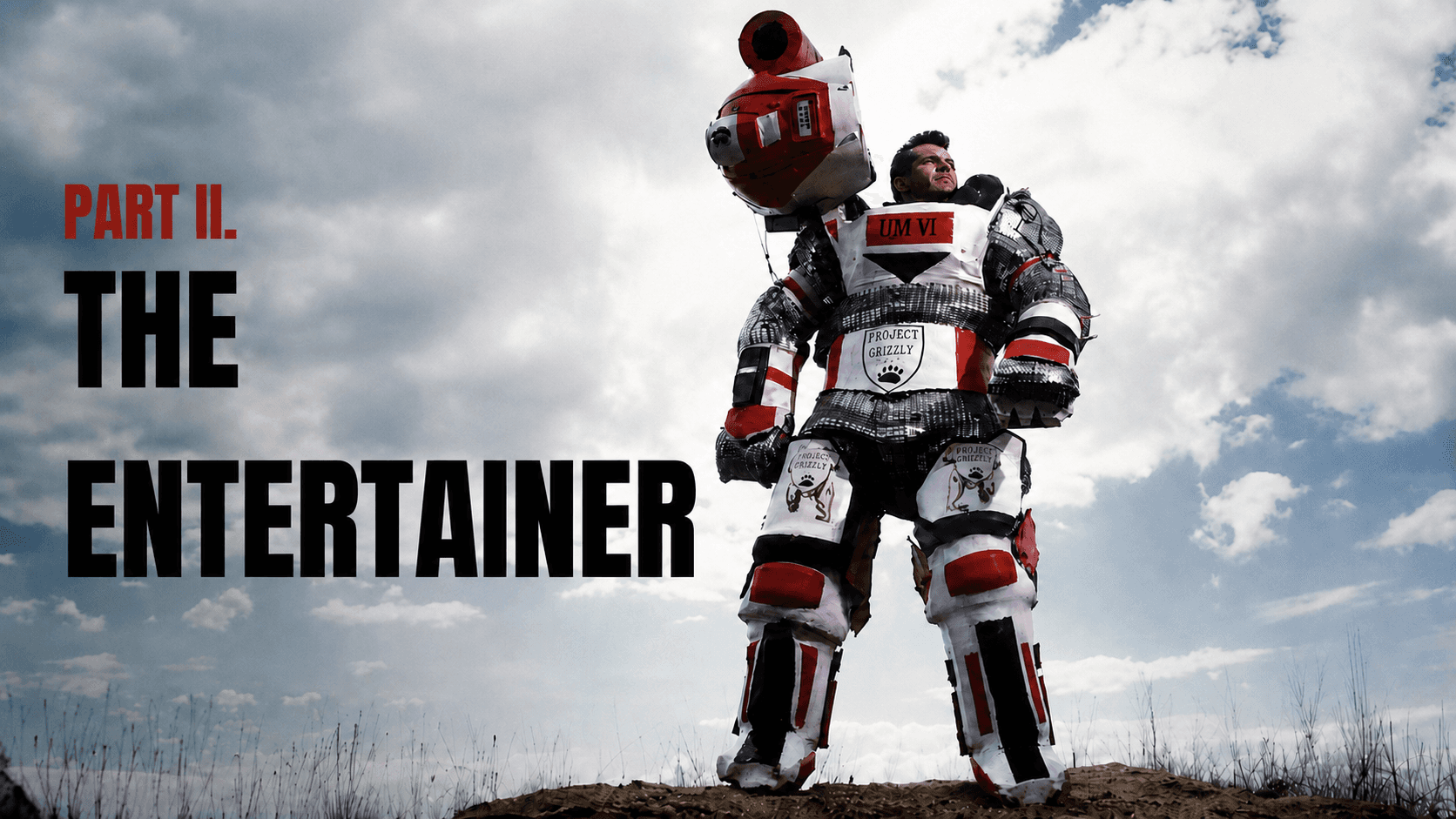
Construction of the first Ursus Protective Suit began in May 1988. It was assembled from a protective material that seven good young Canadian men were bound to have lying around: hockey pads. The crew layered on knee pads, shoulder pads, shin guards, neck guards, and elbow pads, mummifying Troy in a full-body cast. Troy called the first completed suit of armor the Ursus Mark III, skipping over I and II because three was his lucky number.
The first and only foe the Ursus Mark III faced was Troy’s own father. When Troy came home from college and told Maurice his plan to pioneer a new and potentially fatal area of bear research, Maurice was surprisingly receptive. He told Troy it sounded like an interesting idea, worth pursuing. Maurice had never approved of Troy’s wanderings in the wilderness, or of his scrap-metal business, so Troy was overjoyed by his father’s tepid blessing. But when he shuffled downstairs to unveil the Mark III, Maurice was unimpressed. “Get over here,” he told his swaddled adult son. Troy waddled over.
Maurice had been drinking. Without warning, he began attacking Troy, tearing the suit apart with his fingers to illustrate the costume’s obvious insufficiencies, flinging the pieces across the room. The scattered pads, he pointed out, roughly indicated where Troy’s limbs would be had he, Maurice, been a bear. Troy was shaken but grateful. His father used to beat him for no reason. Now, at least his pummeling served a scientific purpose.
Construction of the Ursus Mark IV began in early June. Weighing in at 57 pounds, the Mark IV reprised the Mark III’s reliance on hockey pads. This time, however, the team layered a variety of rigid and shock-absorbing materials underneath the pads: quarter-inch steel plates, bubble wrap, Styrofoam, sponges, and, against Troy’s skin, the secret weapon: a chain-mail jumpsuit designed to protect scuba divers against reef sharks. Additional improvements upon the Mark III included hand and head coverings, in the form of hockey gloves and a motorcycle helmet. The suit cost $2,000 and took 212 hours to build. It was assembled out of 23 individual pieces and took three men two and a half hours to strap onto Troy’s body.
While Troy had no formal background in engineering, he’d spent years gathering discarded copper wires, car parts, and hunks of steel to sell. He was familiar with the latent potential locked within pieces of garbage. So, while the Mark IV was assembled almost entirely of junk, it was sturdy. And it would have to be, because once it was completed, Troy realized that there was no money left in the budget for his trio of impregnable steel cages. It would just be him and the Ursus out there against the bear.
Before tossing their leader to the beasts, the Seven Good Men tested out the suit’s strength against acts of man-made violence. One brutally hot day, they met at a gravel pit in the woods and spent 12 hours trying their hardest to dismantle the device into which they’d invested so much ingenuity and energy, a good deal of money, and the first half of their summer vacations.
They began with bats and wooden boards. Troy stood still while Blair, Stacy, and McKinney took turns teeing off on his knees, shoulders, chest, and head, lightly at first, then full force. The blunt instruments pinged off of the Mark IV’s rigid exterior. From inside, Troy gave the okay to indicate that he was unharmed.
Next, they graduated to a more elaborate test designed to deliver a single crushing blow rather than a flurry of moderately savage whacks. Tossing a rope over a nearby tree, the team suspended a 100-pound punching bag 18 feet in the air, pendulum-style. Below, Troy stood directly in its path. With the release of the rope, the punching bag dropped, sailed noiselessly toward the forest floor, and struck Troy square in the chest. He crumpled to the ground before springing back up. Test two was a success.
The tests were slow going, as Troy could last only 30 minutes inside the Mark IV without overheating. He vomited inside the helmet several times from the blistering internal temperatures. The undressing, cooling off, and re-dressing process took hours, partly because Troy was terribly claustrophobic and had to carefully prepare his mind each time he donned the suit.
The final test, fortunately, was simple. Troy wanted to see how the Ursus would fare in the event that a charging grizzly headbutted it at top speed. Would the suit absorb the blow and cushion his fall, or would it explode, diffusing his body parts alongside the shards? After running some quick calculations, he decided that his father’s 4,000-pound pickup truck, driven at 30 kilometers per hour, exceeded the force generated by even the most formidable grizzly. He asked Maurice to borrow the keys. Maurice asked what for. Troy told his father his plan, and Maurice considered it. Like everything Troy did, this whole suit-of-armor plan might be getting out of hand, Maurice thought. Then again, if Maurice knew his son, he knew that he would find a way to stand in the path of a speeding truck one way or another, with or without his permission.
“Okay, Troy,” Maurice said. “But I’m driving.”
That afternoon, Maurice drove his truck into Troy 18 times. With each impact, Troy grew more pleased, and Maurice grew more proud. By evening, father and son agreed that the Mark IV was ready for a black bear.


The Marks III and IV
Unfortunately, black bears weren’t quite ready to face the Mark IV.
The experimental design seemed foolproof: Under cover of darkness and sealed inside the Mark IV, Troy would lie stationary in the center of a dump (operated by his cousin’s husband’s boss, who was sympathetic to the project’s cause) while the team camouflaged him with piles of delicious trash: old meat, rotten eggs, fish heads, and honey. Hopkins, the sharpshooter, would position himself strategically and prepare to intervene with covering fire if necessary. The remaining five good men would stand around, cameras and notepads at the ready.
The point was to establish whether the Ursus could withstand an attack and therefore if it could be relied upon in later tests involving repellents. When the local bears approached, Troy would leap out and startle them, sure that the surprise would provoke an assault. In reality, the mere sight of the Mark IV—a massive black shape dripping with rotten flesh and severed heads—sent them scurrying.
While black bears are impressive predators, capable of killing an unarmored man with a single swipe, they aren’t grizzlies. They’re timid animals. For nine straight nights, the team repeated the experiment, eventually perfecting the art of luring the bears to within inches of Troy’s concealed body. But, invariably, the bears fled. As the failures piled up, tensions began to run high among the crew. On the ninth night, Hopkins declared, “I’ve been done out of a job by some ball-less bears,” and Troy called off the expedition, declaring it a failure. The Mark IV was scuttled, which is to say that Troy tore it off his body in a fit of rage and left the pieces in the dump.
The utter failure of the Expedition of ’88 (as they decided to call it) meant only one thing for Troy: He would gather renewed enthusiasm for building a new Ursus and for the upcoming Expedition of ’89.
The Mark V was in every way an improvement upon its predecessors. Weighing in at 87 pounds, the exterior this time was only 70% hockey pads, the remaining 30% being a carefully selected mix of other protective sports gear (5% football, 10% baseball, 3% lacrosse, 2% skiing, and 10% motocross, according to Troy’s field notes). The interior was a thick layer of highly absorbent polymer, and another chain-mail jumpsuit. The head protector was, again, a motorcycle helmet, this time modified by means of a steel cage welded across the faceplate. The entire suit was held together with 762 ⅓-inch steel bolts. It cost $26,000 to make and took 363 hours to build. It was buoyant and bulletproof, and Troy could climb inside it in a mere 25 minutes with the help of just two technicians.
In addition to bats and boards, the Mark V could withstand a near-endless barraging by sledgehammer. It easily shook off an impact by a 140-pound punching bag, this time swung from a height of 25 feet. Maurice gunned the pickup truck up to 50 kilometers per hour, and Troy survived. It also passed two brand-new tests: 1) Troy stood inside an ice rink while his brother Stacy pelted him with hockey pucks, and 2) one of Troy’s professors dropkicked him down the Niagara Escarpment, a 150-foot, 65-degree sheer limestone face overlooking the city of Hamilton. He bounced five times and landed in a bush.


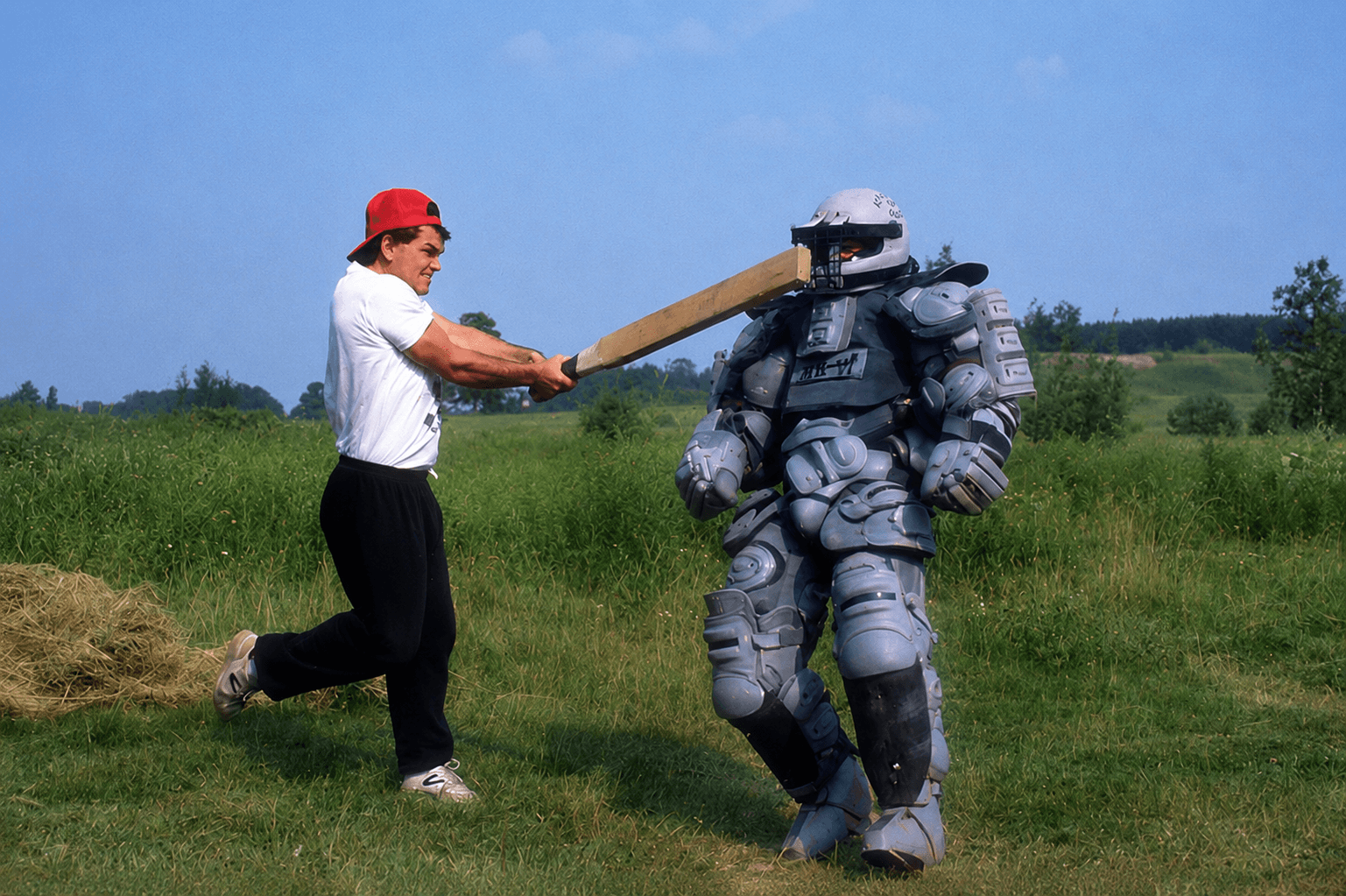
The Mark V
The following summer saw the Seven Good Men heading back to the dump with higher-tech equipment and a more daring objective. Instead of seeking to discover whether the Ursus could withstand an assault from a furious black bear (which had been the goal of the Expedition of ’88), they would use the relative safety afforded by the Ursus to test a new hypothesis: Should hikers rely upon the age-old wisdom that, when it comes to escaping an aggressive black bear, offense is the best form of defense? In other words, since they had already tried and failed to get black bears to attack Troy, the new plan was for Troy to attack the bears.
The Seven Good Men piled into a borrowed RV and headed north, loaded up with enough provisions for a weekslong adventure. Troy followed in his new car, a black Dodge Challenger. For four nights, the crew searched Ontario’s dumps fruitlessly for bears. It was as though the bears had heard they were coming and fled. Like cowboys, they killed time around camp by playing cards and eating corn on the cob. They kept watch and slept in shifts, but eventually it was decided they would need to take more drastic measures. Troy chartered two vessels to take them downriver to a dump famous for its ravenous bears.
On the way to the boat launch, Troy came around a bend on a dirt road and collided head-on with a pickup truck, knocking himself unconscious against his windshield. The Challenger was totaled, but the pickup was relatively unscathed. Hopkins administered first aid while information was exchanged, and then Troy ordered the Challenger abandoned. All Seven Good Men pressed on to the dock in the RV. Troy was concussed and losing blood, but retreating to the city for proper medical attention would have meant missing their rendezvous with the boats, and their quest would have been over.
The wind was cold on the water, and the men grew apprehensive as they began noticing bears gathering on either shore. At their destination, there was practically a swarm. They wasted no time in collecting data. Troy leapt out of the boat and into the Mark V, sat down in the center of the dump, and camouflaged himself as he had the summer before.
The first bear to wander into the dump the crew called Earlybird, for obvious reasons. Hoping to establish a reference point for future tests, Troy acted as if Earlybird didn’t exist. He sat motionless as the bear approached, stood on the Mark V’s shins, and peered curiously into the helmet. Before Earlybird could figure Troy out, he was scared off by a larger bear, which the crew dubbed the Spaghetti Bandit, since he went straight for a plate of pasta. Again, Troy sat absolutely still while the Spaghetti Bandit rummaged through the dump. In time, the second bear, too, was scared off, by an even bigger third bear, a massive male the crew nicknamed Big Joe. Big Joe headed straight for the Mark V and began licking the helmet. Pleased with the reference point he’d established, Troy decided at last it was time to act. He sat bolt upright and swung at the bear. Big Joe dodged the blow and fled without a fight.
The first test was a success, evidence that aggression would deter a startled black bear. But there was no time to rejoice. Troy reassumed his position, and, surprisingly, moments later Big Joe wandered back into the dump. He approached Troy from the rear, cautiously and deliberately. The bear seemed utterly disoriented, unsure of what had just occurred. Assimilated back into the piles of trash, Troy waited patiently. Minutes passed. Only when Big Joe had seemingly convinced himself that he had hallucinated the entire bizarre incident did Troy act again: He sat up and swung at Big Joe with an open palm, this time making contact with the bear’s shoulder. Horrified, Big Joe lashed out with lightning quickness, striking Troy once in the face, hard, before scurrying off.
Troy was dazed and ecstatic. For the first time ever, the Mark V had come into contact with a bear, and it had emerged unscathed.
The crew repeated the same experiment for six consecutive days and nights, traumatizing and inconveniencing dozens of bears. Troy employed all methods of antagonism: sprinting at the bears, leaping, clapping, kicking, growling. He succeeded in coming to blows only with Big Joe, however. By their own hypothesis—that offense was the best defense—each bear scared away was positive data, but Troy still couldn’t help feeling frustrated with the beasts’ cowardice. He wanted to test his mettle.
After nearly a week surrounded by hungry bears, the Seven Good Men’s nerves were frayed. Troy, however, felt the expedition required a finale. In the name of science, he conducted a control trial on the final night by stripping out of the Mark V and assailing the bears nearly naked. The crew feared for Troy’s safety, but they agreed that the risk was necessary. After all, they reasoned, what if offense is the best defense only when you’re dressed like RoboCop?
The suitless tests progressed as usual, with each bear fleeing. Eventually, the crew considered the results conclusive and suggested going to sleep. Troy refused. He continued to pitch himself at bear after bear. Eventually, it became clear to the Seven Good Men that their leader had something stranger than science in mind. They went to bed, leaving Troy to thrash alone in the still silence of the spotlit testing zone.
At the end of two summers’ research, Project Grizzly had provoked a total of 81 black bears. Not a single bear had touched the Mark IV, one had struck the V, and not a single shot had been fired. In Troy’s mind, these figures represented a poignant mosaic of failure and success. The bad news was that the Ursus Protective Suit was still virtually untested against a bear of any kind. The good news was that the crew had proven, they felt, that aggression was a practical deterrent strategy against a black bear. Troy had also, in slapping Big Joe, achieved another breakthrough: the first documented, scientifically administered human-on-bear attack, of which he was very proud.
The footage from the Expedition of ’89 was edited into a 30-minute documentary, which Troy called In Search of an Answer. The film opens with a still shot of a full moon rising over a forest, then cuts to a hawk soaring through the sky, then a butterfly landing on a flower. It’s an earnest movie, complete with an unceasingly melancholy piano soundtrack and narration performed by a man with a broadcasterly mid-Atlantic accent. “This test was a complete success in all aspects,” the narrator states calmly as Troy ricochets limply down a cliffside.
Troy spent his last year at Fleming writing his first self-published memoir, White Tape, which doubled as a compendium of Project Grizzly’s findings. The blurb on the back, attributed to someone named Alanna J. MacBride but written in suspiciously similar syntax to the book itself, reads, “Controversial, melodramatic, poignant, meticulous. Hellbound, yet…heavensent.” He hoped its sales would fund future research: further tests of the Ursus, and, once the Ursus was complete, repellent-spray tests. His greatest ambition was to use the Ursus to crawl undetected into a grizzly’s winter den, affix a camera to the cave wall, and become the first person to film a wild grizzly birth.
Troy graduated in the spring of 1990, alongside several members of Project Grizzly. Now no longer classmates, the crew decided to take an indefinite hiatus. The disbanding was amicable.
The following fall, Troy took a trip to visit his brother Blair, who had moved to a town called North Bay. There, in the Country Style Donuts, Troy saw a woman named Lori, a Bell Telephone operator on her day off. Dressed in a black leather trench coat, Troy introduced himself. Lori thought Troy looked odd, a bit crazy, possibly even dangerous. But she thought he was handsome, too, and she liked that he seemed clean. Troy asked Lori if she’d seen Dances With Wolves. She hadn’t, but she’d read the book. The book is always better than the movie, Lori said. Troy agreed. He told her he was an author, in fact. She asked what he wrote about. He told her he wrote about himself, and about his indestructible suit of anti-bear armor. She laughed, and Troy asked to see her again, promising to bring along his memoir. Lori said sure.
Soon after, Troy and Lori met again at the same Country Style. Troy handed Lori his book, and she handed him $15. He insisted it was a gift, but she insisted on paying. Troy was thrilled. In the year since he had written it, he hadn’t sold a single copy.
Before long, Troy and Lori were going on dates outside the donut shop. Lori read Troy’s memoir cover to cover, and she told him what she thought. She thought he was insane, but, at the same time, she admired his rebelliousness and utter belief in himself. Lori’s mother had dedicated her life to raising her on her own, working constantly, saving every penny, and she had instilled the value of humility and sacrifice in her daughter. Lori started working at 14. She had two jobs by the time she was a senior in high school. Troy, meanwhile, was crashing indefinitely at his little brother’s and seemingly had no plans to use his new college degree to find stable employment. He went back to peddling scrap metal because he couldn’t imagine taking orders from anybody. Troy was so alien to Lori that she couldn’t look away. He invited her and her friends over to Blair’s and showed them VHS tapes of him getting beaten with hammers, hit by trucks, and tossed down hillsides. They had never seen anything like it.
Troy and Lori were married in a quiet ceremony 11 months later, in April 1992, surrounded by family and friends. At the reception, Troy wore the Mark V. Four months later, Lori gave birth to a son, Brett. It was a quiet, happy time. Lori went to work, Troy scrapped. They bought a navy Dodge pickup truck and a little two-bedroom house in North Bay.


Troy, Lori, and Brett
At the same time Troy was starting his own family, his parents’ marriage was falling apart. Maurice’s drinking finally became too much for Claudette, and Maurice moved west to start over. Furious at his father for failing his mother, Troy stopped speaking to Maurice. Maurice didn’t try to reach out.
Perhaps uncoincidentally, around that same time the dream of Project Grizzly went into hibernation inside Troy’s mind. He never stopped talking about how he planned to revolutionize biology with his invention, but there were no more tests, no more expeditions, no more suits. Just Troy and Lori, a house, and baby Brett. A year and a half passed quietly and predictably. It seemed like he was finally content.
But on the inside, Troy was dying. The Edge beckoned. On a gray winter’s day in 1994, he walked out of his house and into the snow. He crossed his backyard and entered the aluminum shed he always said would one day be his laboratory. He picked up his welding torch, opened the acetylene nozzle, slammed some steel on the table, and fused the jagged scraps together into a helmet the size of a mini-fridge. When he was finished, he wrapped it in duct tape and painted it Canadian red and white. On the front, in black Sharpie, he inscribed “Mark VI.”
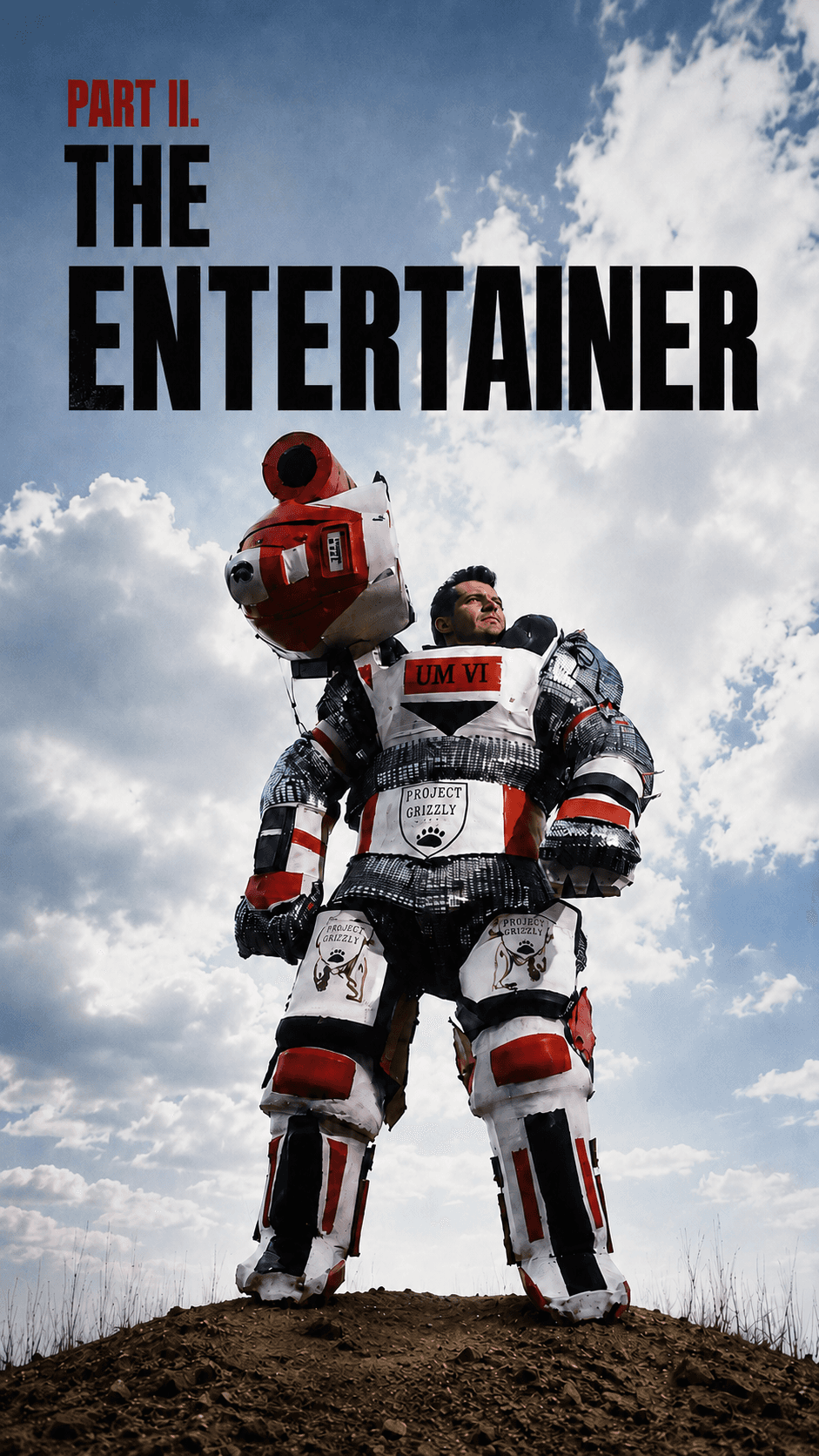
October 1995, Scalp Creek, Alberta
Wearing a red beret, a buckskin jacket, and buckskin boots trimmed with rabbit fur, and carrying three blades—two ivory-tipped throwing knives and one massive bowie—Troy Hurtubise rides a white horse over a flat expanse toward snowcapped mountains. Behind him trails a pack train several miles long—34 men on horseback, including 11 professional hunters, three professional horse wranglers, two cooks, three ex-military snipers (armed to the teeth), his brother Blair, his uncle, his neighbor, and an entire film crew outfitted with cameras, lights, generators, and microphones. Overhead flies a Bell 206 helicopter. Dangling well below the chopper, suspended from a steel cable, hangs the Ursus Mark VI, a boxy, 7-foot-tall behemoth blazing red and white against the pale gray sky.
It’s an impressive display, financed by the taxpayer. The expedition, only just begun, will serve as the climax of a documentary produced by Canada’s National Film Board (NFB), a publicly funded organization that typically makes movies about classic Canadiana, things like ice fishing, hockey, and Leonard Cohen. Months earlier, a shrewd young NFB producer spotted a story about the Mark VI in a local newspaper—Troy had wasted no time in publicly unveiling his creation—and decided it was an opportunity to try something more experimental. The producer called Troy and arranged a meeting in North Bay, during which Troy enthusiastically showed off the suit’s strength by having Blair bash him with a barbell to impressively minor effect. Hands were shaken, contracts were drawn up and signed, and soon a camera crew was filming Troy testing the Mark VI against unprecedented traumas: He trussed up a 400-pound log in the woods and let it swing directly into his chest; a renowned marksman shot the suit with a bow and arrow, and then with a rifle; and Troy walked through a wall of flame.
The Mark VI passed with flying colors. In terms of impenetrability, it was the best Ursus yet, by far. Its only weaknesses were stiffness and low visibility. To minimize points of failure, Troy had declined to include knee or elbow joints, so he shuffled around like a massive Lego figurine, and he had included only 15 pin-size holes in the solid steel helmet out of which to peer. But to Troy, these compromises were entirely necessary, since the Mark VI would need to withstand the blows of the foe he had so long awaited. The second half of the film would feature a journey into the wilds of western Canada and, if all went according to plan, culminate in a showdown between himself and a wild grizzly.
This was everything Troy had always dreamed of. He would lead a team of seasoned professionals, equipped with all the latest gadgets, supported by land and sky, into an unforgiving wilderness in search of an unspeakable danger. Hurtling toward The Edge, he would make history and, at the same time, document his accomplishment. He would be a mountain man and a scientist and a stuntman, Jeremiah Johnson and Jacques Cousteau and Bruce Lee all rolled into one. Only one melancholy detail tempered Troy’s ecstasy: Before flying out to Alberta, Troy called his father for the first time since the divorce. He told Maurice the good news and asked if he might like to join the team he was putting together. After all, Maurice had always believed in Project Grizzly, and his wisdom had contributed to its earliest successes. Troy wanted his father to be there to share in his triumph. Maurice told his son he wasn’t interested.

The Mark VI
After pitching camp 12 miles out into the bush, Troy and his team commence drilling for the upcoming encounter. The plan is this: They’ll survey the landscape from a vegetated bluff. When the time comes, Troy will wait for the bear in the meadow below. The sharpshooters will cover him from various points along the ridgeline. The bear will emerge from timberline, and Troy will provoke it into an attack. The goal of the experiment is simple: See if Troy survives.
God willing, the Mark VI will absorb the bear’s blows with ease, and Troy will tolerate the mauling until the bear loses interest and returns to the forest. In the case of a disaster, Troy will shout the code word “whiskey” into the Mark VI’s built-in walkie-talkie, and the sharpshooters will light up the valley with firecrackers and bombs until the bear flees.
That night, by the light of the fire, Troy rallies the troops by discussing The Edge. Blair admits that everything about the expedition puts him on The Edge. He’s terrified of the bear, of course, but even incidental elements of the adventure make him feel frighteningly alive. Before that morning, he had never ridden a horse or been to the Rocky Mountains. Whenever he’s with Troy, he’s on The Edge, he says. One of the sharpshooters, an American Army vet, talks about his Vietnam days. When his unit was lucky enough to go long periods without action, they entertained themselves by dropping grenades at their own feet and sprinting away, playfully evading the shrapnel. He’s chased that feeling since, and now, thanks to Troy, he’s found it.
The crew asks Troy how he’ll achieve the transcendent peril of The Edge once the Mark VI is victorious over the grizzly. What will he build then? Troy smiles thoughtfully. “I don’t know,” he says. “Another suit?”
The next morning, Troy mentally and physically prepares for the encounter by running through a martial-arts routine. He strips down to a sleeveless white undershirt and white tights, dons his beret, and stands shoeless in the meadow, squatting, striking the air with his hands and feet, and swinging a stick around with blistering precision. Meanwhile, the sharpshooters ascend the ridgeline, and the Mark VI is placed into position nearby. When Troy is ready, Blair, Troy’s uncle, and one of Troy’s neighbors assemble the suit around his body. Like squires, they first lift him up and into the legs, then lower the chest plate and helmet over him, then slide on the arms, and finally screw it all together. Troy, now twice as large with the suit on, sets off across the pasture.
He face-plants so fast that the camera doesn’t even catch it.
Without articulated elbows or knees, Troy’s unable to get up once he topples over, and he begins to panic. It’s an un-leader-like display, but his already severe claustrophobia has only intensified as the suits have grown heavier and more elaborate. He’s begun having nightmares about being abandoned while sealed inside his own creation.
“Son of a bitch,” Troy says when finally his handlers unscrew the helmet from the Mark VI’s body. A meeting is convened, and it’s decided that the Ursus is no match for even the most gently undulating topography. It’s top-heavy. A perfectly planar stretch of meadow will need to be scouted, and somehow the bear will have to be lured there.
Unfortunately, the weather soon turns, and snow begins dusting the valleys between the peaks, delaying further attempts. The crew settles into their tents to wait out the storm. The cameras, however, keep rolling, and Troy entertains them with a variety of antics and anecdotes, slinging his knives into nearby trees, shaving his face with his bowie, and delivering perhaps his finest rendition of the Old Man Story. The weather continues to deteriorate, but Troy holds out hope. The crew grows demoralized. Several members privately ask the film’s director what will become of the documentary without a bear attack. The film isn’t about the bear, the director replies, or even about the Mark VI. It’s about Troy.
When, on the fifth morning, the film crew begins packing up their equipment, Troy is confused and distraught. They have all the material they need, the director explains. Troy wonders how that could be. They haven’t so much as spotted a grizzly, let alone performed science upon one. The pack train files out of camp, whisking away Troy’s support team and supplies. Troy follows, but as an act of defiance he refuses to ride his horse, preferring to tramp along behind through the freshly fallen snow.
Then narratives diverge.
In the film, the quest comes to a melancholy and ironic conclusion as, mere miles from civilization, the crew happens upon a grizzly feasting on a horse carcass in a flat meadow. “This is Fate laughing at me,” Troy proclaims, staring out at the bear. The conditions are close to ideal, except for one crucial detail: The Mark VI is 10 miles away, back up the mountain. When they left, Troy spitefully left it behind. Obstinately, he vows to return to the Rockies in the spring to finish his quest, and the picture fades to black.
In reality, Troy didn’t take Fate’s laughter in stride. He flipped out, flew into a fury, and started walking toward the bear. The camera crew scrambled, unsure whether to record or intervene. They never expected this moment to come. Despite what Troy had been led to believe, the National Film Board had never actually secured the necessary permissions to allow him to grapple with a grizzly. Secretly, they had chosen to film in locations that locals had told them were devoid of bears. Now, at the last possible moment, they ran into one anyway.
The bear was several hundred yards away, preoccupied with its meal. Troy headed straight for it, ignoring all entreaties to turn around. The sharpshooters scaled a ridgeline and began firing over Troy’s head, shelling the area between their leader and the grizzly. Troy pressed on through the blasts. The bear appeared unconcerned. Bullets and bombs pelted down. Soon, only a short distance and a small fence stood between Troy and the grizzly. Troy began scaling the fence.
Finally, the explosions persuaded the bear to run off, denying, once again, Troy’s apparently abiding desire to face a bear in unarmed combat. He was heartbroken.

Alberta
Project Grizzly, as the movie was called, debuted at the Toronto International Film Festival in September 1996, to high praise. The Vancouver Sun gave it four stars, as did the Edmonton Journal. Quentin Tarantino saw the film and called it one of his favorite movies of the year. It was marketed as a comedy. The poster called Troy “a modern-day Don Quixote.”
At just 72 minutes, Project Grizzly is a lean portrait, but a poetic one. The Mark VI is juxtaposed with B-roll of medieval suits of armor, and the climactic expedition sequence is edited together in the style of a lost Sergio Leone epic, complete with twangy acoustic guitar. The film strives to evoke Troy’s perception of events, rather than “reality,” so to speak. True to what he told the crew, the director, Peter Lynch, made a film about Troy, not a film about grizzly bears.
Ironically, Troy’s most emotionally naked moment—when he realizes that his dream has slipped through his fingers, and so in blind agony marches suit-less straight at the bear—doesn’t appear in the film. The cameras were rolling, but the incident was cut for fear that it made Troy appear unlikable.
After its release, Troy soon became a minor celebrity across the U.S. and Canada, known briefly to newspaper reporters and DJs coast to coast as some variation of “Bear Suit Guy.” The moniker was indicative of how the public perceived him: with equal parts fascination and derision. Initially, Troy didn’t seem to pick up on the mockery; all publicity was good publicity, he thought. All he knew was that people knew his name, and some of them were offering to pay him to speak about how he wanted to fight a grizzly bear. He didn’t want to fight a grizzly bear, he’d calmly explain, but rather to study them up close. He took every opportunity to lecture talk-radio audiences on the subject of close-quarters bear research. But no matter what he said, to the media, the Ursus Protective Suit was a joke, and all the better that it was a joke Troy didn’t seem to be in on.
He was invited by a satirical engineering society to speak at Harvard and receive a fake award (the Ig Nobel Prize, for trivial research), which he considered a real honor. Then he was asked to dance on stage with Penn and Teller in Las Vegas while wearing the Mark VI. He introduced himself to the audience as a bear behavioral specialist, and then Teller, dressed as a bear, rode a battering ram onto the stage and knocked him over before Penn interviewed him while standing on his chest. Soon The Simpsons had parodied the Ursus, and Discovery Channel was showing up at Troy’s door to film segments and pitch series. He obliged every request, no matter how small, relishing his newfound fame.
Lori and Troy worked as a team. She managed the money and the scheduling, while he gave the people what they came for: impassioned speeches and live demonstrations of the Mark VI in action against bats, boards, and bullets.
While Troy’s dreams of achieving scientific acclaim seemed more remote than ever, in a sense he had achieved an even older aspiration: his childhood dream to be an entertainer.


Six years after the premiere of Project Grizzly, Troy Hurtubise stood in a puddle of gasoline in a ditch outside North Bay, Ontario, locked inside a jet-black, sarcophagus-size casing of armor designed to evoke a 19th-century deep-sea-diving suit. In front of him stood a digital camera on a tripod, which cast a faint glow in the night air. Through 3 inches of titanium, he shouted “Action!” The cameraman rolled the tape, lit a match, and flicked it.
As soon as the match hit the tarp, it was obvious that Troy had made a terrible mistake. Night turned to day as the gas exploded into a 15-foot fireball, with Troy standing at the epicenter. Recognizing his error, he tried to flee the conflagration, but the Mark VII’s mobility was worse than the VI’s. He stumbled and, in a grotesque reenactment of his greatest humiliation, fell flat on his face. The flames swam over him.
Troy rode the wave of Project Grizzly as long as he possibly could, paying the bills by conducting countless radio and TV interviews, licensing his own archival footage of the Ursuses, and making live appearances in the Mark VI. He did everything in his power to keep the flame of his fame alive. At first, the phone rang off the hook. But over time, it fell silent for 24 hours at a shot, then a week, then a month. He fixated on the intervals, developing a manic dependence on the opportunities delivered, unpredictably and as if by magic, through the receiver. When a job came, he was over the moon. In a dry spell, he cast a long shadow over the Hurtubise home, over Brett and Lori.
When six quiet months had passed, years after Project Grizzly’s premiere, the money finally ran out. Troy filed for bankruptcy and turned over his most valuable asset, the Mark VI, to the bank.
Lori had never stopped working, even at the height of Troy’s fame, despite his assurances that their troubles were over. She always insisted on maintaining an income, working a series of minimum-wage jobs. If only barely, she kept the family afloat.
A dark period followed. Troy started sleeping a lot, guzzling coffee compulsively while awake. In many ways, things were as they had been before Project Grizzly, but now he’d had a taste of success. He went back to scrapping, but combing the streets of North Bay and the back roads of northern Ontario for shards of jagged metal no longer felt quite like freedom.
Little Brett, who’d realized early on that not everybody’s dad was on Discovery Channel, took Troy’s fall from fame hard. Once, when Brett was 10, Troy spotted his son through the kitchen window, playing in the backyard. The boy had wrapped himself in cardboard and towels and slid PVC pipes over his limbs, cobbling together a crude suit of armor. Another little boy stood behind a shopping cart at the opposite end of the yard.
“Okay,” Brett said. “Slam the sucker into me, now.”
Troy’s heart leapt as the other boy tore across the lawn, sending the shopping cart directly into Brett’s chest. Brett flew backward and landed noiselessly on the grass. He didn’t scream. He just lay there. Then he said, “Again, harder.”
“That’s enough, boy,” Troy called calmly out the open window. “Come on in now.”
Troy undressed Brett down to his long johns and inspected his wounds while his son gazed up at him, his brown eyes showing no sign of the trauma his body had endured. His lip was cut, and his chest was purple with bruises. Troy kissed Brett’s head and sent him on his way. Overcome with pride and regret, Troy went into his laboratory to weep.
Disillusioned by the lack of control he felt over his quest following Project Grizzly, Troy let his dreams of further experiments and expeditions languish. But then, in late 2001, while dropping off a haul at the local scrapyard, he spotted something among the rubble that struck him as a sign that it was time to stage a comeback: a hunk of titanium. Describing the moment years later in his second self-published memoir, Bear Man, Troy wrote, “One is never allowed even a partial look at life’s personality, for life is an entirely secretive son-of-a-bitch. But sometimes when he says hello, it’s a wild fucking ride. Life said hello to me that autumn morning.”
Convincing the junkyard owner, a friend, to gift him the titanium, Troy heaved it home and immediately set about wrestling the metal into the shape of his own still-spry body. For eight months, he heaved and hammered and smelted in his basement, working 20 hours a day and loving every minute. The result was the Ursus Mark VII, Troy’s strongest, most stylish, and most technologically advanced suit to date.
The improvements of the Mark VII upon the Mark VI were threefold: 1) greater visibility—instead of peering out of pinholes, like a knight, Troy could now scan the landscape through two bulletproof, wallet-sized windows; 2) total self-sufficiency—for the first time ever, he was able to don the suit independently, without a support team, as it was one contiguous piece that swung open and shut at the front like a dress shirt; and 3) indestructibility—the suit was even tougher than its impossibly sturdy predecessors, as Troy found out when a friend rammed him through a brick wall with a front-end loader.
The success of the front-end-loader test convinced Troy that it was time for redemption. The Mark VII, he felt sure, was his ticket to gathering the funds necessary for staging another expedition, on his own terms, and for filming another documentary, Project Grizzly 2.
During screenings of the original Project Grizzly, Troy had noticed that audiences responded positively to the scene in which he shuffles heroically through a waist-high wall of fire. Seeking to replicate that image in order to print a movie poster, and thereby attract investors, Troy loaded the Mark VII into his pickup along with several gallons of fuel and a camera, picked up an amateur videographer who ran the local hardware store, and headed for the gravel pits outside of town. Last time around, Troy felt the crew had wasted theatrical potential by allowing the gas to seep into the soil. So this time he laid down a tarp, poured a puddle, and stood in the center.

The Mark VII
In 14 years of experiments, Troy had never suffered a serious injury while testing the Ursus suits. He had always, in a certain perverse sense, been careful, starting small and slow and ratcheting up the danger incrementally. But after the fire test, he was lucky to escape the Mark VII alive. When the cameraman pulled him out, he was covered in third-degree burns.
Finally disillusioned with the Ursus but still desperate to regain his notoriety, Troy turned his attention post-hospitalization to other forms of innovation that he hoped might be more consumer-friendly. The next force of nature against which he chose to pit himself was the one that had just nearly vanquished him: fire. Mixing together powders and liquids from the hardware store, he cooked up a flame-retardant spray, which he dubbed “Firepaste.” Firepaste rendered any object impervious to heat and flame. Troy tested the stuff by slathering it on a motorcycle helmet and blasting his own head with a blowtorch for 10 minutes, to great success. He hoped Firepaste would prove attractive to homeowners who lived in areas prone to wildfires. They could hastily douse their houses with the stuff as the flames converged around them. Sadly, there was little interest.
Then money got even tighter, and things got stranger. Leaving chemistry behind, Troy turned his attention to electronics. He began taking apart microwaves, combining their inner mechanisms with a variety of loose wires and spare circuits and switchboards, housing the tangled affair within a massive artillery-shell-shaped casing. He focused the resulting energy into a beam, and he claimed that the beam allowed him to see through the walls of his house as clearly as if he was watching television. He called the device the Angel Light.
With the Angel Light, Troy was sure he’d finally struck gold, but there was a catch: The beam had deleterious effects upon living organisms. He placed several hamsters in front of it, and each hamster died. Troy called this unintended feature the Hyde Effect, as in Dr. Jekyll’s evil alter ego. He vowed to rid the device of it. The process nearly killed him. Tinkering in the noxious glow of the Angel Light, Troy’s hair fell out in clumps, and he lost 10 pounds a week. Finally, he succeeded in altering a key mechanism within the machine. He switched it on and found that the effect had reversed: The new beam was lethal to everything but organic matter. A plant placed in front of it would grow at astounding speed. A chair would burst into flames. Troy renamed his creation the God Light.
Nobody ever saw the Angel or God lights in action. Troy had grown increasingly isolated by the time he developed them, and they were so large that they (perhaps conveniently) couldn’t fit through his laboratory door for a public demonstration. By now, Troy was often sleeping for 24 hours at a time, then waking up and staying awake for 50 hours. He was drinking a dozen cups of black coffee a day. In his downward spiral, it seems he gave up on the pursuit of genius and resorted to merely cultivating the appearance of it. He became obsessed with eccentric innovators like Guglielmo Marconi and Nikola Tesla, both of whom claimed in their later years to have invented supernatural ray guns.

The God Light
In 2008, Troy was forced to resell the Mark VI (which he had recently bought back from his bankruptcy trustee with Lori’s money) at auction to a fan for 2,000 Canadian dollars. Soon after, he sold the Mark VII to a different fan. He would never see either suit again. By 2011, Lori had had enough. Troy had become a tragic imitation of his own father, minus the drinking. He was a terror to be around, and since he’d stopped scrapping, he was always home. He showed no interest in Brett, who was then 18 and spending all day playing video games to drown out the chaos. Lori kicked Troy out. He moved in with his mother, who lived in a condo down the road. He spent his waking hours penning his second memoir, which he hoped would be a sensation.
That same year, perhaps in an effort to find the cause of his relentless sense of inadequacy, Troy took a trip to visit his father in Edmonton. They had hardly spoken in more than a decade. Still, Troy claimed to harbor only admiration for his father. He always told Brett how Maurice was a brilliant, impressive man who taught him everything he knew about the wilderness, engineering, hockey, and what it meant to be a father.
But when Troy returned from Edmonton, he was distraught. He visited Lori’s house early in the morning to have a talk with Brett. Sitting at the kitchen table in the cold sunlight, father and son lingered for a long time in silence while Troy stared, seemingly shell-shocked, through Brett and into the next room. Finally, Troy spoke. He didn’t tell Brett what had happened out west, but he said that after seeing his father after all those years, he’d realized that Maurice wasn’t brilliant or impressive at all. He was just a man.
I guess it’s true what they say, Brett thought. Don’t meet your heroes.
Lori took Troy back in 2013, perhaps moved by the fact that Bear Man was not at all a sensation. Soon after, he started work on what would become the final Ursus, the largest and most intricate of them all.
The Mark VIII likely would never have been finished without Brett’s assistance. Brett was 22 at the time, unemployed and living at home. He’d grown into a gentle young man and a caring son to his mother, but, to Lori’s frustration, he had adopted his father’s anti-authoritarian disdain for work. He still loved video games more than anything. One day, he descended the stairs to the laboratory and asked his father what he was working on. Troy responded with a string of obscenities, indicating that a shin pad he was developing wasn’t living up to its impenetrable promise. Brett considered the device, reached down, and flipped it around. Troy was astonished. “You’re a genius, boy!” he told Brett. He extended his hand and asked Brett to join the team.
Despite his early idolization of Troy and his inventions, by his teenage years Brett had grown to resent the Ursus suits and the unreliable man they turned his father into. He showed no interest in Troy’s exploits, and, when he was feeling brave, even openly mocked Project Grizzly. But now, for the first time, Troy was asking for Brett’s help, and Brett realized that he wanted to make his father proud. Oddly, the obsession that had stood between Brett and Troy for so long now looked like an opportunity to make up for lost time. Brett shook Troy’s hand.
For two blistering months, father and son labored on the Mark VIII. Improvements, catalyzed by Brett, included the long-overdue addition of knee and elbow joints, as well as a camera and live video feed, which allowed the user to see without peering out of structurally compromising portholes. The latter was a feature Brett had seen in sci-fi combat games, like Halo. Troy was floored by Brett’s ambition. When the suit was finished, he etched his son’s name across the chest plate.
The Mark VIII debuted to little fanfare. By then, even the local papers were bored by the Ursus. The investors Troy hoped to attract for Project Grizzly 2 never materialized. Both Hurtubise men despaired, until they received a phone call. It was a venture capitalist from America, a man named Christopher Nowells, who told Troy he wanted to be his patron and benefactor, to fund his lifestyle and his innovations, provided that he turn his attention away from bears and toward a more lucrative field: combat armor.
Troy didn’t believe it. He hung up the phone, suspecting a prank. Several days later, he received a check in the mail for $10,000. He deposited it, and the check cleared. Troy called Nowells back, who told him he was prepared to send $10,000 each month, in perpetuity, so long as he pivoted from bear-proof to bulletproof armor. Troy agreed, no questions asked. Immediately, he and Brett rented a storefront in downtown North Bay, cleared it out, and got to work.
What followed were the glory days. Troy had everything he had always wanted: a proper laboratory, professional-grade tools, an income, a staff (Brett), time to work, and zero oversight. Brett had what his young life had lacked (direction) and what he’d always longed for (a relationship with his father).
Troy and Brett worked when they wanted to, on whatever they felt like, so long as it was at least tangentially related to military research. The results were a slew of innovations: a souped-up version of the Mark VIII’s shin guard, called the Kneeshinfoot because it encased the entire lower leg; a lightweight, hyper-absorbent padding designed to line the bottoms of Humvees and protect against IEDs; a polymer that, when applied to a surface as flimsy as a paper towel, hardened into a plate as strong as steel.
Days in the lab were filled with tinkering and testing, blasting Johnny Cash, drinking coffee and smoking cigarettes, and wailing on the punching bag Troy had strung up in the corner. At lunchtime, Troy and Brett went out to restaurants and picked up new toys from the shops on the way home, things Troy had always wanted, like Kevlar and a vat of acid. At night, they watched hockey games, hit the local casino, and hung out into the small hours. In the mornings, they’d wake up late and do it all again. The Hurtubise men were in heaven.


Brett Hurtubise; Troy in the Mark VIII
Meanwhile, Lori toiled at a dead-end job at the post office. At home, she was always tired and often complaining. She and Brett, who had always been close, grew distant as he gravitated toward his father’s outsize lifestyle. Troy told Brett that his mother had worked hard since she was a teenager, and it had gotten her nowhere. He told Lori to quit her job, to quit martyring herself, and presented her with $40,000 cash on the dinner table as proof that the hard times were really over this time. She said it would dry up; it always did. Troy and Brett spent more time at the lab, coming home less often, and later.
For two years, Troy was proven right. The checks came like clockwork. Then, just as Lori had predicted, the dream ended as inexplicably as it had begun. What happened to the mysterious Christopher Nowells, nobody knew. Did his fortune run out? Were the inventions inadequate? Had he died? He simply stopped picking up the phone.
The aftertaste of the good life was too bitter for Troy to stomach. He spiraled, lost the lab, sold off his tools, and developed an expensive dependency on painkillers. His hair thinned, and his body ached from impacts sustained decades ago. Drowning in debt, he pawned the Mark VIII for CA $900, practically begging the local hock shop to take it. Lori moved out again. This time, she didn’t come back. Humiliated and often intoxicated, Troy turned on Brett, terrifying his son with manic, apocalyptic tirades. Brett clung desperately to their budding relationship, trying to draw Troy back toward the light, but his father wouldn’t listen. Eventually, Brett moved out too. Needing space, he blocked his father’s number. He intended their silence to be temporary.
Weeks later, on June 17, 2018, Troy Hurtubise drove his Chevy west down Highway 17 out of North Bay, away from Brett and Lori and his life’s work. It was a sunny summer’s day. The highway was flat and straight. A tanker truck, full of fuel, was approaching from the opposite direction. Just as Troy was about to pass it, he swerved abruptly, crossing the yellow line. The two vehicles collided head-on. Both caught fire immediately. The truck driver was able to climb out of his seat and onto the side of the road. From there, anyone could tell that Troy was already dead. His Chevy was balled up and burning.
In the end, Troy was alone. It’s impossible to know what he was thinking that day, whether his hand slipped or he swerved intentionally in desperate pursuit of The Edge, and whether, in either case, he regretted in the final moment what he had done. The introduction to Bear Man suggests he was just as bewildered by himself as everyone else was.
“My name is Troy Hurtubise,” he wrote, “and I know nothing. My accomplishments are many and none at all. I have nothing, save for a wondrously beautiful wife and son who love me far too much. I have everything.
“My name is ‘The Bear Man’ and I am 47 years old, currently living at my mother’s. My wife and son are apart from me, down the street sharing a single room, for I cannot afford, through my own stupidity, to feed or house either one of them. I have nothing.
“My name is ‘that funny guy in the suit.’ My mother is a diabetic living on a fixed income, which she uses to feed and house her 47 year old son. I am nothing.
“My name is Troy Hurtubise and my mother loves me. I have everything.”
Even now, Lori won’t hear a bad word said about Troy. She lives with a new boyfriend, a kind, quiet guy, just outside North Bay, but she’s kept Troy’s last name.
Claudette lives in a nursing home. Maurice is remarried and still lives near Edmonton. He’s in his 80s now, cheery and articulate and working on a novel, his first, about boyhood. The idea for the novel came to him when his liver failed years back and he “died,” so to speak, on the operating table, before being resuscitated. While convalescing, he sustained himself by looking back on his life, reliving it through memory. Oddly enough, he found his fond recollections ended when he was a teenager, before meeting Claudette, before having his six kids. These days, he doesn’t think very much about his old family or those years. He doesn’t see any point in doing so. The prevailing theme of his novel is second chances. To take advantage of a second chance, he believes, you have to “jettison the past,” erase it from your mind. “I’m a peaceful, happy guy,” he says. “I can close my eyes, take a deep breath, and say, ‘This is good.’” Troy could never do that, he realizes now.
Even when Troy was little, he always confused Maurice. “Troy was a complicated kid,” he says. “He was always trying something different. He needed to do something. He had a destiny of his own, and he was heading towards it and he didn’t even know what it was. He never found what he was looking for.”
Brett has met Maurice only twice, but he’s told he’s grown to look exactly like him. Brett thinks about his father all the time. He’s decided that Troy was born too late. Troy should have been a cowboy wandering the plains, he thinks, or a snake-oil salesman traveling from town to town. He believes his father wasn’t cut out for having a family. He was too selfish. Still, he can’t help admiring his father’s conviction that there was more to life than the prescribed path, that generating a new destiny was as easy as saying the word.
Now Brett has a family of his own. He lives in North Bay with his fiancée and three kids. He works at a call center and spends his days persuading people not to switch internet providers. He says he’s very good at it but finds it deeply unfulfilling. He sits beside a window at the office, and the glare from the overhead lighting casts a reflection of his face onto the pane. Sometimes he stares at the reflection and imagines himself aging decades in the space of a few moments, locking eyes with a tired, barely recognizable man sitting in the same swivel chair.
At home, after the kids have gone to bed, Brett has recently started combing through his father’s archives, sifting through the debris Troy left behind: abandoned pieces of armor, schematics, chemical recipes, notes and ideas dashed off on scraps of paper. He isn’t sure why, more than half a decade after his father’s death, he suddenly feels compelled to catalogue Troy’s miscellany. But he’s following his impulse. He records his journey and uploads the videos to a YouTube channel named, fittingly, after his father’s first documentary, In Search of an Answer. The short videos feature Brett musing on his most recent findings in the archive and meditating on the surreal heartbreak of being the only son of the Bear Man. In one entry, he discusses how surprised and touched he was that he received so many kind messages from strangers in the weeks after Troy died. As it turned out, Troy had inspired thousands of people to follow their dreams. Even, Brett notes, as Troy’s own dream destroyed him.
But now, years later, Brett is worried that Troy’s legacy will fade if he doesn’t keep it alive. The YouTube channel is an effort to immortalize him, to “make sure his life wasn’t meaningless,” he says. “It has to mean something.”
Brett isn’t sure whether Troy was a fraud, a fool, a genius, or all three. His best guess changes by the day. But, whatever the truth, he was still his dad.
Brett doesn’t invent anymore, but he does create. He writes. If his father always felt compelled to do something, Brett feels compelled to say something. Like his grandfather, he’s working on a novel, a horror story about a man wandering through North Bay. A dense fog has settled over the town, and the man is lost. A four-legged demon is on the loose. The man’s only lifeline is a mysterious figure who appears intermittently to offer cryptic directions, cold comforts, warm embraces, and obscenities. He calls the figure the Old Man.
